


Working on the coast with mud and rock calls for an orange peel grab that holds fine material without losing it during hoisting, withstands the impact of stone and does not degrade in salt water. These three requirements pull in different directions and a standard grab rarely meets all of them.
The hydraulic orange peel grab we have just built at Stemm meets all three conditions at once. In this article we explain how we did it: the drive type, the closed shell geometry, the replaceable teeth and the wear protection.
A non-autonomous hydraulic grab: the power comes from the crane
Unlike our electro-hydraulic orange peel grabs, this unit has no built-in hydraulic power unit. The grab body has no motor, pump or tank. Hydraulic power is supplied by an external power unit, usually installed on the crane and provided by the customer. The crane and the grab are connected with quick couplings. This makes it fast to attach and detach the grab without touching the circuit or losing oil, which is especially useful when the crane switches between different tools on the same site.
Without an integrated power unit, the grab puts its weight into structure and working components. The body, shells and cylinders are what actually face the material, and that is where we have added the reinforcement.
Closed shells for mud, teeth for rock
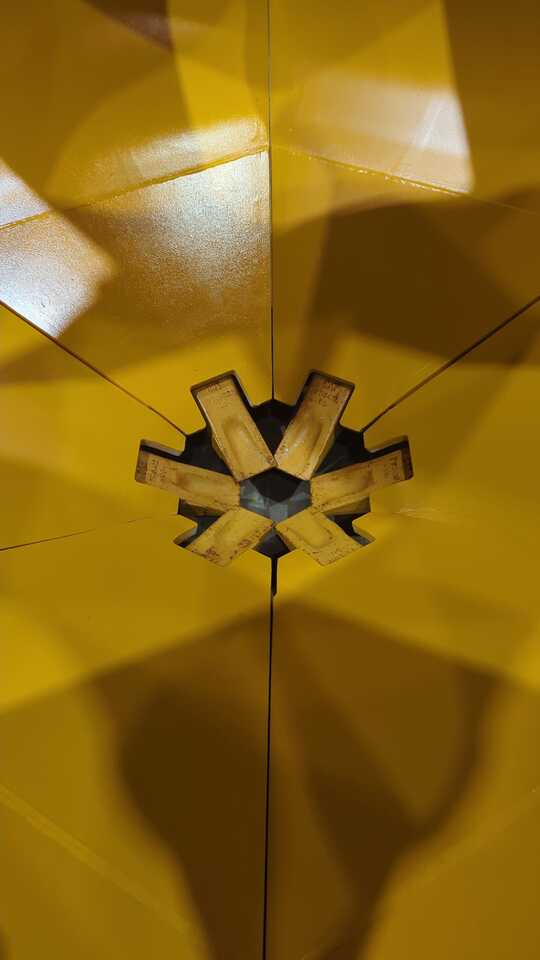
The challenge of handling mud with an orange peel grab lies in the geometry. An open-tine grab grips loose pieces well, but lets fine material escape between the tines. That is why this unit has closed shells: when closed, the shells meet and form a container that holds the mud throughout the lift. The same geometry also has to penetrate rocky ground. To do this, the edge of each shell carries tooth points that concentrate the closing force and make it easier to bite into compact material.
The teeth are replaceable. When they wear, the tips are changed without touching the shell, which extends the service life of the grab and lowers maintenance costs compared with repairing the entire edge.
Reinforced structure and wear plates for the marine environment
The combination of salt water, sand and rock is one of the toughest an orange peel grab can face. Marine mud carries abrasive particles, rock strikes the structure on every cycle and salinity attacks any exposed surface.
That is why we reinforced the structure and fitted numerous wear plates in the areas under the most stress. These plates protect the main body, absorb wear and extend the grab’s durability in continuous coastal service.
As with all our equipment, the grab went through Stemm’s hydraulic test bench before shipment.
When to choose a hydraulic grab over an electro-hydraulic one
The choice depends mainly on the crane. If the crane already has a hydraulic circuit with enough flow and pressure, a hydraulic orange peel grab uses that power and keeps the equipment simpler. If the crane only offers rope and electrical power, the option is an electro-hydraulic orange peel grab with its own integrated power unit. In both cases, we design the geometry of the shells or tines to suit the material and the working environment.
Stemm, manufacturer of hydraulic and electro-hydraulic orange peel grabs
At Stemm we design and build every orange peel grab around the real application: the material, the environment and the crane it will work with. If you have a coastal project with mud, rock or mixed material, you can get an instant estimate in our online configurator or contact our technical team.
